Quick Answer
The best post driver depends on the number and size of posts you're installing, soil conditions, site access, and your budget.
For a handful of T-posts in relatively soft soil, a manual or gas-powered post driver may be all you need. They're inexpensive, portable, and can go almost anywhere.
For larger fencing projects, bigger wood posts, or harder soils, hydraulic equipment becomes much more attractive. A handheld hydraulic driver reduces some of the physical effort, while a skid steer-mounted hydraulic post driver can turn a labor-intensive fencing project into a much faster operation.
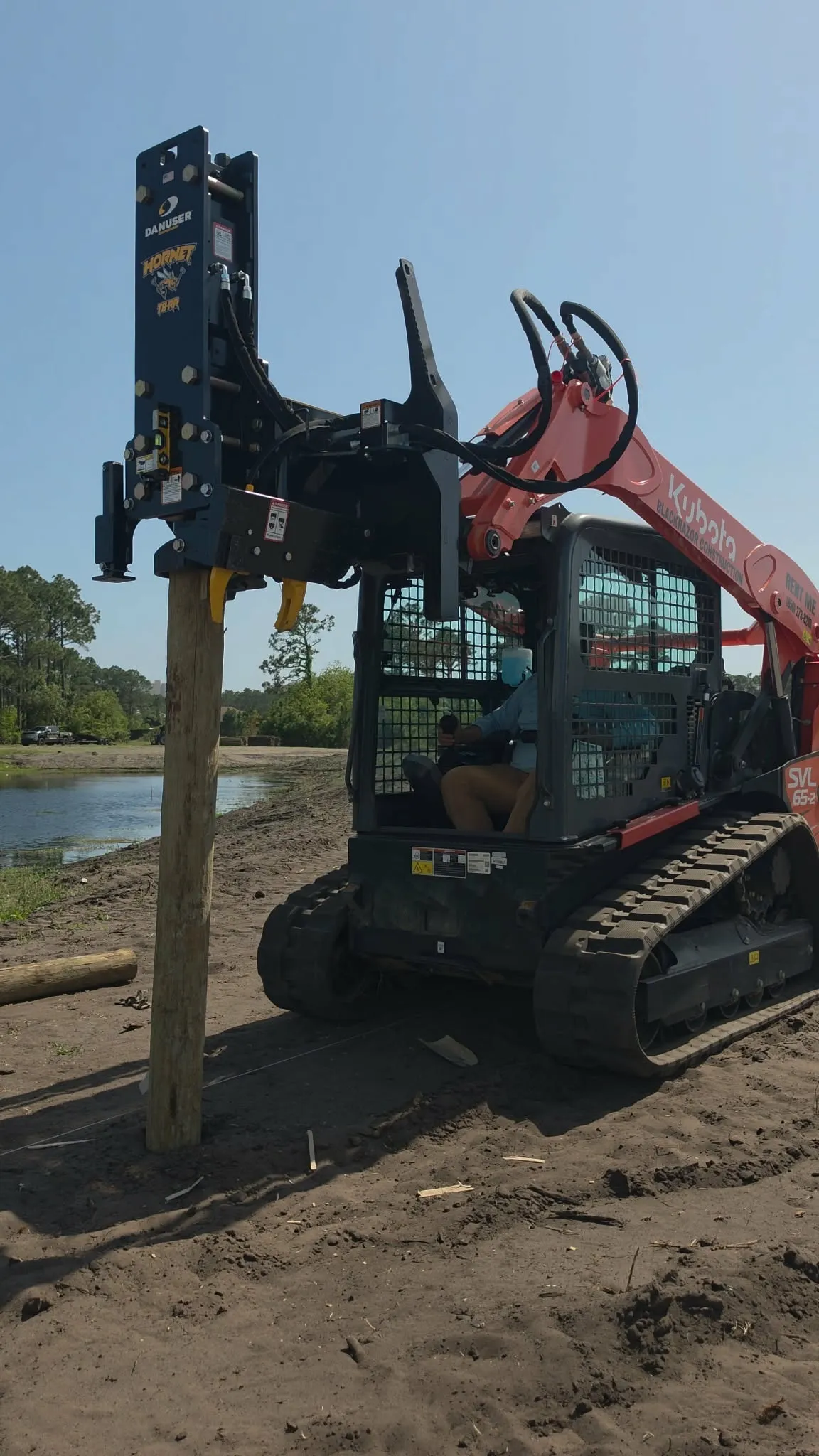
For large fencing projects with good equipment access, our choice is the Danuser Hornet T8-RR hydraulic post driver, available from BlackRazor Rentals. Mounted to a skid steer or compact track loader, the Hornet uses a hydraulic hammer to drive posts while the machine handles the lifting, positioning, and downward force.
Depending on post size, spacing, soil conditions, layout, and operator experience, 60-100+ posts in an 8-hour workday can be achievable - but production can vary substantially from one jobsite to another.
BlackRazor Rentals provides post driver and equipment rentals throughout Santa Rosa Beach, 30A, Destin, Freeport, Panama City Beach, and surrounding areas.
What's the Best Way to Drive Fence Posts?
There's no single post driver that's best for every fence.
Installing six T-posts around a garden is completely different from installing several hundred wood posts around a farm or large property.
Before choosing a post driver, consider:
- Number of posts
- Post diameter and material
- Required embedment depth
- Soil conditions
- Rocks, roots, and other obstructions
- Equipment access
- Available labor
- Rental cost
- How quickly the project needs to be completed
As the number and size of posts increase, the value of mechanizing the job increases dramatically.
Here's how the most common options compare.
Manual Post Drivers
A manual post driver is about as simple as it gets.
It's typically a heavy steel tube with handles that slides over a T-post or smaller fence post. You repeatedly lift the driver and slam it downward onto the top of the post.
Where Manual Post Drivers Work Best
Manual drivers make sense for:
- Small DIY fencing projects
- T-posts
- Sign posts
- Temporary fencing
- Garden fencing
- Locations inaccessible to equipment
- Installing only a handful of posts
They're inexpensive, require no fuel or hydraulic power, and are extremely portable.
Advantages
Low cost: A manual driver is generally the least expensive option and may be cheap enough to purchase instead of rent.
Simple: There are essentially no controls, engines, hydraulics, or moving parts to learn.
Excellent accessibility: If you can walk to the location carrying the driver, you can probably install a post there.
No machine required: You don't need a skid steer, excavator, compressor, hydraulic power unit, or other equipment.
Drawbacks
The biggest drawback is obvious:
You provide all the power.
Driving a couple of posts isn't a big deal. Driving dozens of them can become exhausting.
Hard or compacted soil makes the process substantially more difficult, and larger wood posts may simply be beyond the practical capabilities of a manual driver.
Manual drivers are cheap in terms of equipment cost, but potentially expensive in terms of time and physical labor.
Gas-Powered Post Drivers
Gas-powered post drivers are a significant step up from manual driving.
These portable machines use a small gasoline engine to repeatedly hammer the post into the ground. The operator still carries and positions the machine, but the engine performs the hammering.
Where Gas Post Drivers Work Best
Gas drivers are particularly useful for:
- T-posts
- Smaller round posts
- Sign posts
- Vinyard posts
- Agricultural fencing
- Medium-size fencing projects
- Remote areas where heavy equipment can't reach
They're an excellent middle ground between a manual driver and bringing heavy equipment onto a property.
Advantages
Portable: You can carry a gas driver almost anywhere.
Faster than manual driving: The machine supplies the impact instead of your arms.
No hydraulic machine required: Everything needed to operate the driver is contained in the unit.
Good for moderate-size projects: If you have dozens rather than hundreds of smaller posts, a gas driver can make a lot of sense.
Drawbacks
Gas-powered doesn't mean effortless.
You still have to carry, lift, position, and control the machine at every post. That adds up over an entire day.
Gas drivers can also struggle as post diameter increases or ground conditions become more difficult. Rocks, roots, extremely compacted soil, and larger wood posts can quickly expose the limitations of a portable machine.
There's also an engine to fuel and maintain, along with the vibration and physical effort associated with operating a handheld machine.
Handheld Hydraulic Post Drivers
Handheld hydraulic post drivers use hydraulic pressure rather than a small gasoline engine to produce the hammering action.
These can provide substantial driving force while maintaining some of the accessibility advantages of handheld equipment.
They're often used for:
- T-posts
- Steel posts
- Sign posts
- Guardrail or specialty posts
- Agricultural fencing
- Jobs requiring more power than small portable drivers
Advantages
Hydraulic drivers can provide strong, consistent impact without relying on a small gasoline engine mounted directly to the tool.
They can be an excellent solution when you need significant driving capability but can't physically access the work area with a skid steer or track loader.
Drawbacks
The biggest issue is that hydraulic power has to come from somewhere.
Depending on the equipment, that may mean a hydraulic power pack, tractor, skid steer, or another hydraulic source.
And despite being hydraulically powered, the operator is still handling and positioning the tool.
For a moderate number of posts, that's manageable. For hundreds of posts, the labor requirement becomes much more significant.
Skid Steer-Mounted Hydraulic Post Drivers
This is where post installation changes considerably.
Instead of the operator carrying the post driver, the entire attachment is mounted to a skid steer or compact track loader.
The machine carries the attachment, positions it over the post, supplies hydraulic power, and allows the operator to drive the post from the cab.
For large fencing projects, the difference in productivity can be substantial.
Where Skid Steer Post Drivers Work Best
Machine-mounted hydraulic drivers are particularly well suited for:
- Farm fencing
- Horse fencing
- Agricultural fencing
- Large residential properties
- Commercial fencing
- Wood fence posts
- Round posts 5"+
- Large number of T-posts
- Long property lines
- Large acreage
- When posts are covered with hazardous chemicals (i.e. Creosote posts)
If you have hundreds of posts to install and enough room to operate a machine, this is generally where a skid steer-mounted driver starts making a lot of sense.
The Danuser Hornet T8-RR Hydraulic Post Driver
For larger post-driving projects, BlackRazor Rentals offers the Danuser Hornet T8-RR hydraulic post driver.
The Hornet mounts to a skid steer or compact track loader and uses hydraulic hammering action to drive posts directly into the ground.
You can view our Danuser Hornet T8-RR Post Driver rental for additional rental information.
Instead of manually lifting a driver over every post, the machine does the heavy work.
The operator can position the attachment, align the post, drive it, move to the next location, and repeat the process.
For long fence lines, that can mean a huge reduction in physical labor.
How Many Fence Posts Can You Drive in a Day?
There's no responsible way to guarantee a specific number because every jobsite is different; however, we've seen a local ranch here in Northwest Florida drive 60-80 creosote posts in a day and a local Vinyard drive 100+ 5" diameter posts in a day.
Production depends on:
- Post spacing
- Post diameter
- Post length
- Required depth
- Soil conditions
- Rocks and roots
- Terrain
- Machine travel distance
- Whether locations are already marked
- How posts are staged
- Operator experience
- Number of people working
Under favorable conditions with an organized jobsite, 60–100+ posts during an 8-hour workday can be achievable with a skid steer-mounted hydraulic post driver.
That can represent a substantial labor savings compared with manually installing the same posts.
The key is workflow.
If your posts are staged, locations are marked, and one person can assist with positioning while another operates the machine, production can move quickly.
If every post requires measuring, retrieving material from across the property, navigating obstacles, or dealing with rock, production will naturally be lower.
Soil Conditions Matter
Knowing the ground underneath your fence can be just as important as the post driver you choose.
Soft or Sandy Soil
Florida's sandy soils can make post driving relatively easy in many locations.
Manual and gas drivers may perform perfectly well with smaller posts, while a hydraulic machine can make extremely fast progress on larger projects.
Clay and Compacted Soil
Hard or compacted ground requires considerably more energy.
This is where hydraulic equipment becomes increasingly valuable.
A post that takes substantial effort with a manual driver may be much easier to install with repeated hydraulic hammer impacts.
Roots
Roots can slow down any post-driving method.
Smaller roots may be penetrated or displaced, while substantial roots can stop or redirect a post.
Never assume that additional hammering force will solve every obstruction.
Rock and Buried Obstructions (Including Utilities)
Rocky ground can significantly reduce production.
A post driver isn't a magic solution for solid rock, buried concrete, or other major obstructions. In some situations, the location may need to be moved, pre-drilled, excavated, or otherwise prepared before the post can be installed.
And before driving posts, always make sure underground utilities have been properly located.
Choosing the Right Post Driver Hammer
One advantage of a professional hydraulic post driver is the ability to configure the hammer or driving tool for different applications.
Different hammer faces are designed to interact with the top of the post differently.
Flat Hammer
A flat hammer face provides a broad driving surface and is useful when you want the impact distributed across the top of the post.
It can be appropriate for many general post-driving applications where maintaining the condition of the top of the post is important.
Beveled Hammer
A beveled hammer concentrates the impact differently and can be useful for applications where a more aggressive driving action is desired.
The appropriate hammer ultimately depends on the type, shape, diameter, and material of the posts you're installing.
Using the correct setup helps improve driving performance and reduces unnecessary damage to the post. Using a beveled hammer on standard posts can "mushroom" the head or cause the top edges of the post to splinter after multiple strikes.
What Are the Drawbacks of a Skid Steer Post Driver?
As productive as a hydraulic post driver can be, it's not the right tool for every project.
Higher Rental Cost
You're renting a hydraulic attachment and you need a compatible skid steer or compact track loader to operate it.
That makes the equipment cost considerably higher than buying a manual post driver or renting a portable gas-powered unit.
For five posts, it probably doesn't make financial sense.
For 100 posts, the calculation looks very different.
Machine Access
You need enough space for the machine to reach the fence line.
Narrow gates, buildings, landscaping, steep slopes, wet areas, septic systems, and other obstacles can prevent or complicate access.
Ground Disturbance
A compact track loader is heavy.
Although tracks distribute the machine's weight better than tires in many situations, repeatedly traveling across finished lawns or sensitive landscaping can still cause damage.
Operator Experience
A skid steer or compact track loader is powerful heavy equipment.
The operator needs to be comfortable controlling the machine, positioning the attachment, and working around people, structures, utilities, fences, and other obstacles.
Which Post Driver Should You Choose?
The best post driver isn't necessarily the biggest one.
If you're putting up five T-posts, grab a manual driver.
If you're installing a few dozen smaller posts in an area a machine can't access, a gas or handheld hydraulic driver may be the better solution.
If you're building hundreds or even thousands of feet of fencing, that's where the productivity of a skid steer-mounted hydraulic driver becomes difficult to ignore.
You're paying more for the equipment, but you're potentially buying back a tremendous amount of time and physical labor.
That's the tradeoff.
Post Driver Rentals in Santa Rosa Beach, 30A, Destin & Panama City Beach
For larger fencing projects in Northwest Florida, BlackRazor Rentals offers the Danuser Hornet T8-RR hydraulic post driver along with compatible compact track loader equipment.
We provide equipment delivery throughout Santa Rosa Beach, 30A, Destin, Freeport, Panama City Beach, and surrounding areas of Northwest Florida.
Our delivery-based rental model means you don't have to own a heavy-duty truck and equipment trailer or figure out how to transport a skid steer and post driver yourself. We deliver the equipment to your jobsite and pick it up when the rental is complete.
If you're planning a fence and aren't sure whether a manual, gas, handheld hydraulic, or skid steer-mounted post driver makes sense, contact BlackRazor Rentals and tell us about the project.
The best equipment isn't always the biggest or most expensive machine.
It's the equipment that gets your particular job done safely, efficiently, and with the least unnecessary labor.